Crypto Backend Redesign
Overview
This document defines the target architecture for the Trustpoint cryptography redesign.
It is intentionally opinionated and does not preserve the current credential-centric crypto design. The goal is to replace the current mixed software/PKCS#11 implementation with a maintainable architecture that gives Trustpoint one application-facing crypto backend while keeping PKCS#11 concerns fully contained.
This document is the target-state design for future work. It does not describe the current implementation. For the current credential architecture, see Credentials - Architecture.
Status
This is a design-and-implementation blueprint for the planned redesign.
Goals
Trustpoint application code uses one crypto backend interface.
PKCS#11 is the custody and provider model for persistent server-held keys.
Trustpoint business code does not know whether the provider is SoftHSM, a simulator, or a hardware HSM.
Low-level PKCS#11 concerns stay in one adapter layer.
Long-lived private keys are not stored in the Trustpoint database.
One-time downloadable credentials remain supported through backend-controlled export flows.
Vendor-specific PKCS#11 library differences are handled centrally.
Bootstrap, restore, concurrency, error mapping, and observability are part of the design rather than bolt-ons.
Non-Goals
Redesigning Trustpoint ingress TLS termination.
That remains out of scope for this crypto redesign.
Preserving the current
CredentialModelcrypto abstraction.Preserving the current KEK/DEK/backup-password design around
PKCS11Token.Allowing PKCS#11 concepts to appear in forms, views, request processors, or business services.
Repository Findings That Drive This Design
The redesign is grounded in the current repository structure and pain points:
pki.models.credential.CredentialModelcurrently mixes certificate persistence, software key storage, PKCS#11 key references, HSM import/generation, and runtime key reconstruction.management.pkcs11_utilmakes PKCS#11 keys imitatecryptographyprivate key interfaces, which leaks provider and mechanism details into the rest of the application.management.models.pkcs11.PKCS11Tokencurrently mixes token metadata, PIN retrieval, session handling, KEK/DEK management, backup-password recovery, and runtime crypto state.Request and business flows sign directly with raw key objects in modules such as:
devices.issuerrequest.operation_processor.issue_certrequest.operation_processor.signrequest.operation_processor.csr_signpki.util.crlrequest.message_builder.cmprequest.message_responder.cmp
Export/download flows in
devices.views.downloadassume a generic stored credential can always be turned back into PKCS#12 or PEM.Global storage toggles in
management.models.key_storage.KeyStorageConfigforce application code to think in terms of software-vs-HSM storage instead of use-case policy.
Core Design Decision
Trustpoint will expose one application-facing backend:
CryptoBackendis the only crypto boundary used by application code.Trustpoint does not branch on software vs HSM vs SoftHSM.
The implementation family behind that backend is PKCS#11-based.
Development and demo profiles use SoftHSM or an HSM simulator through the same backend contract.
The application sees one backend. Provider differences are handled by backend configuration and capability probing, not by application branching.
Use-Case Model
The design separates crypto use cases by lifecycle, not by provider type.
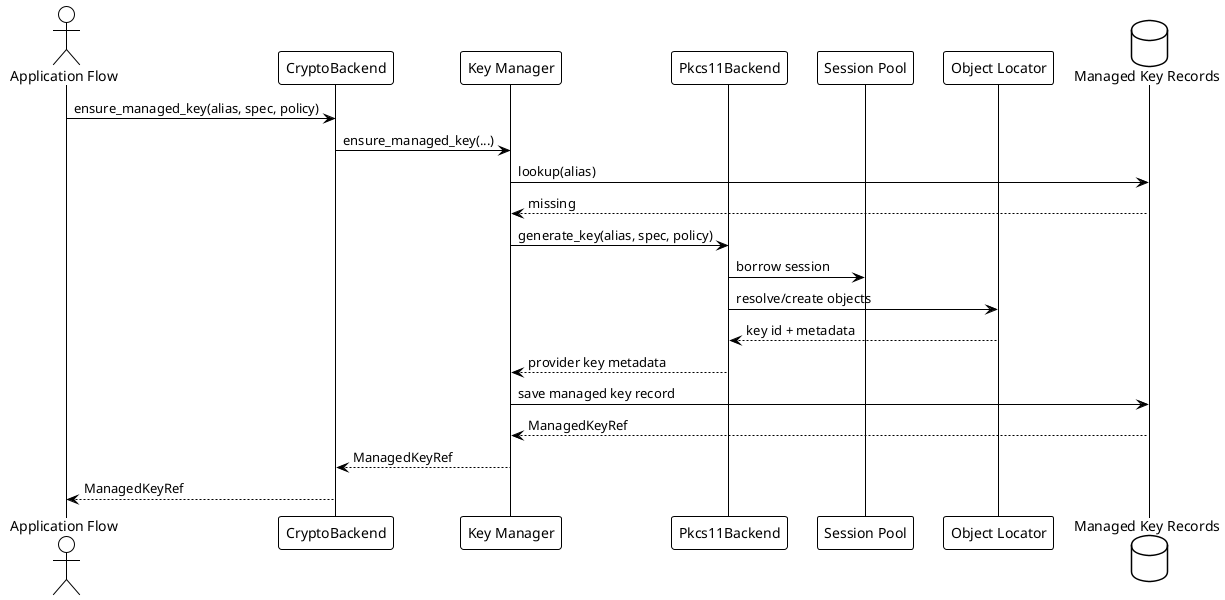
Managed Keys
Managed keys are long-lived keys that Trustpoint keeps using after creation.
Examples:
local root CA keys
local issuing CA keys
signer keys
CMP/EST response signing keys
other persistent server-held private keys
Properties:
stored and used through PKCS#11
referenced by stable backend identifiers
non-exportable by default
restored by rebinding to the provider and verifying that the key still exists
Export Bundles
Export bundles are one-time delivery artifacts produced for downstream devices.
Examples:
downloadable PKCS#12 packages
password-protected PEM ZIP/TAR bundles
temporary server-generated credentials that are shipped once and then used outside Trustpoint
Properties:
created through the same
CryptoBackendnot treated as Trustpoint-managed long-lived keys
may use provider-native exportable flows or backend-owned transient generation, depending on provider capabilities
persisted only as metadata and audit information, not as reusable long-lived private keys in the DB
This separation is critical. It avoids forcing one-time delivery credentials into the same lifecycle as persistent CA and signer keys.
Top-Level Architecture
![@startuml
!theme plain
skinparam componentStyle rectangle
package "Trustpoint Application" {
[Devices / PKI / Request Flows] as App
[CryptoBackend] as Backend
}
package "Crypto Application Layer" {
[Key Manager]
[Certificate Service]
[Signing Service]
[Bundle Export Service]
[Secret Protection Service]
}
package "Provider Layer" {
[Pkcs11Backend]
[Provider Profile]
[Capability Probe]
}
package "PKCS#11 Adapter Layer" {
[Session Pool]
[Object Locator]
[Mechanism Policy]
[Error Mapper]
}
package "Persistence" {
[Managed Key Records]
[Credential Records]
[Export Bundle Records]
[Provider Profile Records]
}
App --> Backend
Backend --> [Key Manager]
Backend --> [Certificate Service]
Backend --> [Signing Service]
Backend --> [Bundle Export Service]
Backend --> [Secret Protection Service]
[Key Manager] --> [Pkcs11Backend]
[Certificate Service] --> [Pkcs11Backend]
[Signing Service] --> [Pkcs11Backend]
[Bundle Export Service] --> [Pkcs11Backend]
[Secret Protection Service] --> [Pkcs11Backend]
[Pkcs11Backend] --> [Provider Profile]
[Pkcs11Backend] --> [Capability Probe]
[Pkcs11Backend] --> [Session Pool]
[Pkcs11Backend] --> [Object Locator]
[Pkcs11Backend] --> [Mechanism Policy]
[Pkcs11Backend] --> [Error Mapper]
[Key Manager] --> [Managed Key Records]
[Certificate Service] --> [Credential Records]
[Bundle Export Service] --> [Export Bundle Records]
[Pkcs11Backend] --> [Provider Profile Records]
@enduml](../../_images/plantuml-10d5ffd0911b8948a000964f611d714b0ef08b7f.png)
Layer Responsibilities
Application / Business Layer
Application code may:
request a key by alias or role
ask for signing, certificate issuance, verification, or export bundle generation
receive stable domain-level objects such as
ManagedKeyReforExportBundleRef
Application code may not:
import
pkcs11open sessions
choose mechanisms
track object handles
load PINs
branch on provider type
Crypto Application Layer
This layer exposes the stable backend contract and orchestrates use cases:
KeyManager: generate, import, lookup, public-key retrieval, existence checksCertificateService: certificate issuance, CSR creation, CRL issuanceSigningService: sign, verify, hash, MACBundleExportService: one-time exportable credential bundlesSecretProtectionService: application secret protection for values such as onboarding secrets
Provider Layer
The provider layer contains the implementation family used by Trustpoint:
Pkcs11Backendprovider profile loading
capability probing
vendor-specific overrides
Trustpoint may support multiple PKCS#11 provider profiles over time, but the application-facing contract remains one.
PKCS#11 Adapter Layer
This is the only place that knows about:
library loading
slot/token selection
login and relogin
session pooling
object lookup by
CKA_IDand labelmechanism selection
provider-specific quirks
error normalization
Target Package Structure
The target Python package structure should look roughly like this:
trustpoint/crypto/
  domain/
    algorithms.py
    errors.py
    policies.py
    refs.py
    specs.py
  application/
    backend.py
    keys.py
    certificates.py
    signing.py
    bundles.py
    secrets.py
  adapters/
    pkcs11/
      backend.py
      config.py
      capability_probe.py
      session_pool.py
      locator.py
      mechanisms.py
      error_map.py
      vendor_overrides.py
  django/
    models.py
    repositories.py
Backend Contract
The application-facing backend should be small and operation-oriented.
class CryptoBackend(Protocol):
    def ensure_managed_key(self, alias: str, spec: KeySpec, policy: KeyPolicy) -> ManagedKeyRef: ...
    def import_managed_key(self, alias: str, pkcs8_pem: bytes, policy: KeyPolicy) -> ManagedKeyRef: ...
    def get_managed_key(self, alias: str) -> ManagedKeyRef: ...
    def public_key(self, key: ManagedKeyRef) -> PublicKey: ...
    def sign(self, key: ManagedKeyRef, data: bytes, request: SignRequest) -> bytes: ...
    def issue_certificate(self, issuer: CredentialRef, subject: PublicKey | ManagedKeyRef, spec: CertificateSpec) -> IssuedCertificate: ...
    def create_csr(self, key: ManagedKeyRef, spec: CsrSpec) -> CertificateSigningRequest: ...
    def issue_crl(self, issuer: CredentialRef, spec: CrlSpec) -> CertificateRevocationList: ...
    def create_export_bundle(self, request: ExportBundleRequest) -> ExportBundleRef: ...
    def read_export_bundle(self, bundle: ExportBundleRef) -> ExportBundlePayload: ...
    def protect_secret(self, plaintext: bytes, purpose: SecretPurpose) -> ProtectedSecret: ...
    def unprotect_secret(self, protected: ProtectedSecret) -> bytes: ...
Key Referencing Strategy
The redesign must stop relying on label-only PKCS#11 references.
Managed keys should be referenced by:
internal Trustpoint UUID
stable application alias
provider profile id
PKCS#11 object identity based primarily on
CKA_IDoptional human-readable label
stored public-key fingerprint
algorithm and capability metadata
Object handles are never persisted. They are session-local runtime details inside the PKCS#11 adapter.
Provider Profiles
The current KeyStorageConfig and PKCS11Token models should be replaced by an explicit provider profile model.
Provider profile fields should include:
profile name
PKCS#11 module library path
token selector:
serial number preferred
label optional
slot index only as fallback
authentication source:
environment variable
file path / secret file
external secret provider hook
optional mechanism overrides
optional vendor name / driver family
active flag
last capability probe result
This makes different HSM vendor libraries a configuration problem instead of an architectural fork.
Capability Probing
At startup and whenever a provider profile changes, the backend should probe and cache capabilities such as:
supported key generation mechanisms
supported sign mechanisms
supported curves
supported RSA sizes
wrap/unwrap support
object copy/import constraints
login/session quirks
The rest of the backend uses a mechanism policy that selects from supported options instead of hardcoding SoftHSM assumptions.
Managed Key Flow
Export Bundle Flow
Export bundles are intentionally separate from managed keys.
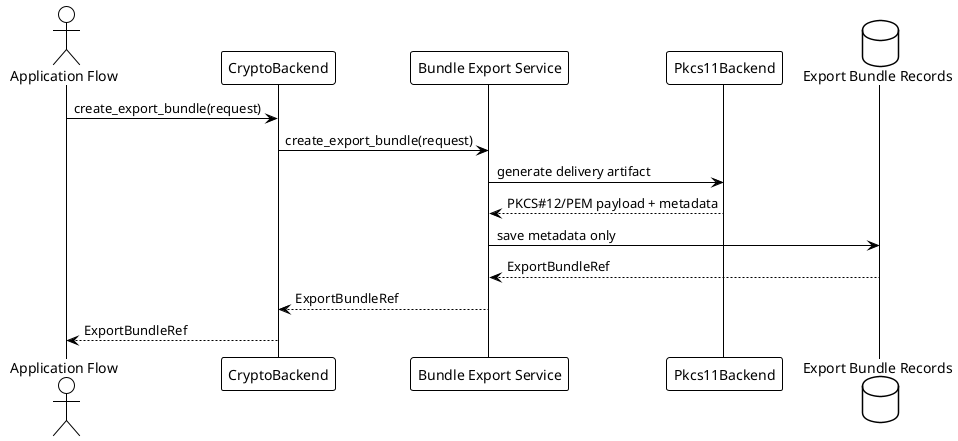
The backend may implement this using:
exportable PKCS#11 objects where the provider supports it, or
backend-owned transient key generation for delivery-only credentials
The application does not care which path was used.
Sessions, Login, and Concurrency
PKCS#11 session management must be centralized.
Rules:
load each PKCS#11 library once per process
keep one provider object per active profile
use a bounded session pool per provider profile
login when a session is created or borrowed, depending on provider behavior
never share raw session objects with business code
always reacquire object handles per session
treat handles as ephemeral
Expected session-pool behavior:
borrow/release for each operation
retry once on invalid-session or provider-reset errors
surface clear degraded-mode errors if the provider is unavailable
Certificates and Credential Records
Certificates and chains remain database records. Private key custody does not.
The future replacement for the current credential records should store:
leaf certificate id
chain certificate ids
managed key reference for persistent keys, if applicable
export bundle reference for delivery-only credentials, if applicable
role / usage classification
certificate status metadata
The DB stores certificate-related state and key references. It does not store reusable private key material for managed keys.
Secrets Protection
The current encrypted-field design should be replaced by a dedicated secret protection service.
It must not:
call
PKCS11Token.objects.first()from a model fielddepend on application startup cache state
mix field serialization with provider login/session logic
It should:
use the same
CryptoBackendboundaryhave a dedicated purpose model
rotate or rebind cleanly during restore
keep secret protection independent from credential issuance flows
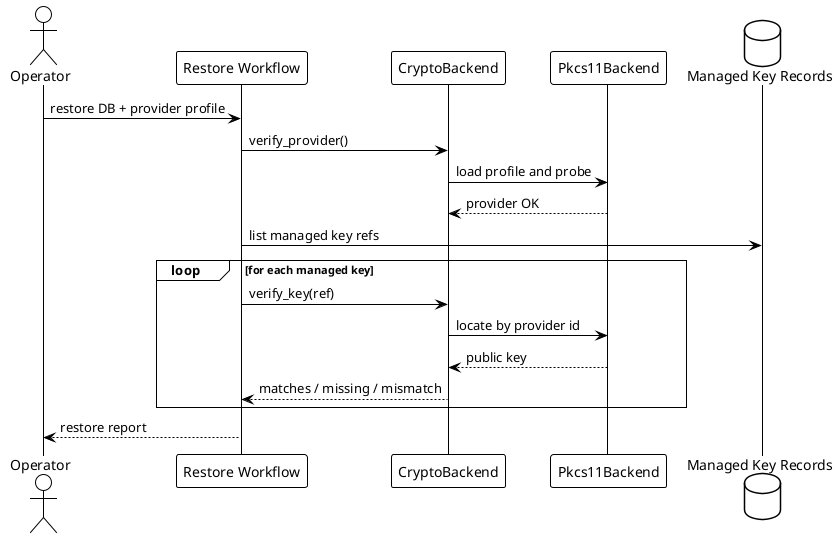
Bootstrap and Restore
Bootstrap and restore must be explicit backend workflows.
Bootstrap responsibilities:
configure active provider profile
validate module path and token selection
authenticate successfully
probe capabilities
persist provider profile metadata
create managed keys lazily or explicitly, depending on feature policy
Restore responsibilities:
restore DB state
rebind to the configured provider profile
verify that referenced managed keys still exist
verify that stored public-key fingerprints still match
mark missing keys as degraded state instead of failing silently
Error Handling
The backend must expose a small, domain-oriented error model.
Recommended error categories:
ProviderUnavailableErrorProviderAuthErrorManagedKeyNotFoundErrorMechanismUnsupportedErrorKeyPolicyViolationErrorExportNotAllowedErrorBundleExpiredErrorSecretProtectionErrorTransientProviderError
All low-level PKCS#11 exceptions are mapped centrally.
Observability
Every backend operation should emit:
operation name
provider profile id
algorithm
mechanism chosen
latency
success/failure
normalized error type
Logs must never contain:
PIN values
plaintext secrets
private key material
full sensitive payloads
What Should Be Removed
The redesign explicitly replaces the following current architectural elements:
pki.models.credential.CredentialModelas the main crypto abstractionmanagement.models.pkcs11.PKCS11Tokenmanagement.models.key_storage.KeyStorageConfigas a global software-vs-HSM switchmanagement.pkcs11_utilas a public crypto layerPKCS#11 usage in forms, views, request processors, and Django models
DB storage of long-lived managed private keys
Summary
The target architecture is:
one application-facing crypto backend
PKCS#11-backed persistent key custody
SoftHSM/simulator for dev and demo
explicit provider profiles for vendor library support
managed keys separated from one-time export bundles
no PKCS#11 leakage into Trustpoint business code
no DB-stored long-lived private keys